About Hagastaden
Next to the historic buildings of Vasastan, a new urban district has emerged, seamlessly connecting Stockholm with Solna. Hagastaden is a fresh addition to Stockholm’s inner city, stretching from Karlbergsvägen in the west to Bellevueparken in the east, and from Norra Stationsgatan in the south across to the Karolinska hospital area in the north. Construction began in 2010 and is expected to be fully completed by 2030, though it is already a bustling, vibrant neighborhood today. Covering 96 hectares, Hagastaden is three times the size of Gamla Stan (The Old Town). Its blocks are full of contrasts between the past, present, and future, showcasing brilliant examples of spectacular, experimental, sustainable, and urban architecture. Once fully developed, the district will accommodate 50,000 workplaces and 7,000 homes. The central parts of Hagastaden are now largely finished, currently boasting 3,100 new homes and 300,000 square meters of office and retail space. Over the coming years, the final phases of the neighborhood will be completed, introducing more housing, offices, green spaces, sports and cultural facilities, elderly care homes, schools, preschools, and hotels. Thanks to a wealth of innovations, research breakthroughs, and international influences, Hagastaden will continue to evolve far into the future. Welcome to a neighborhood buzzing with creativity, brought to life by everyone who lives, works, and operates here.


A Unique Geographical Location
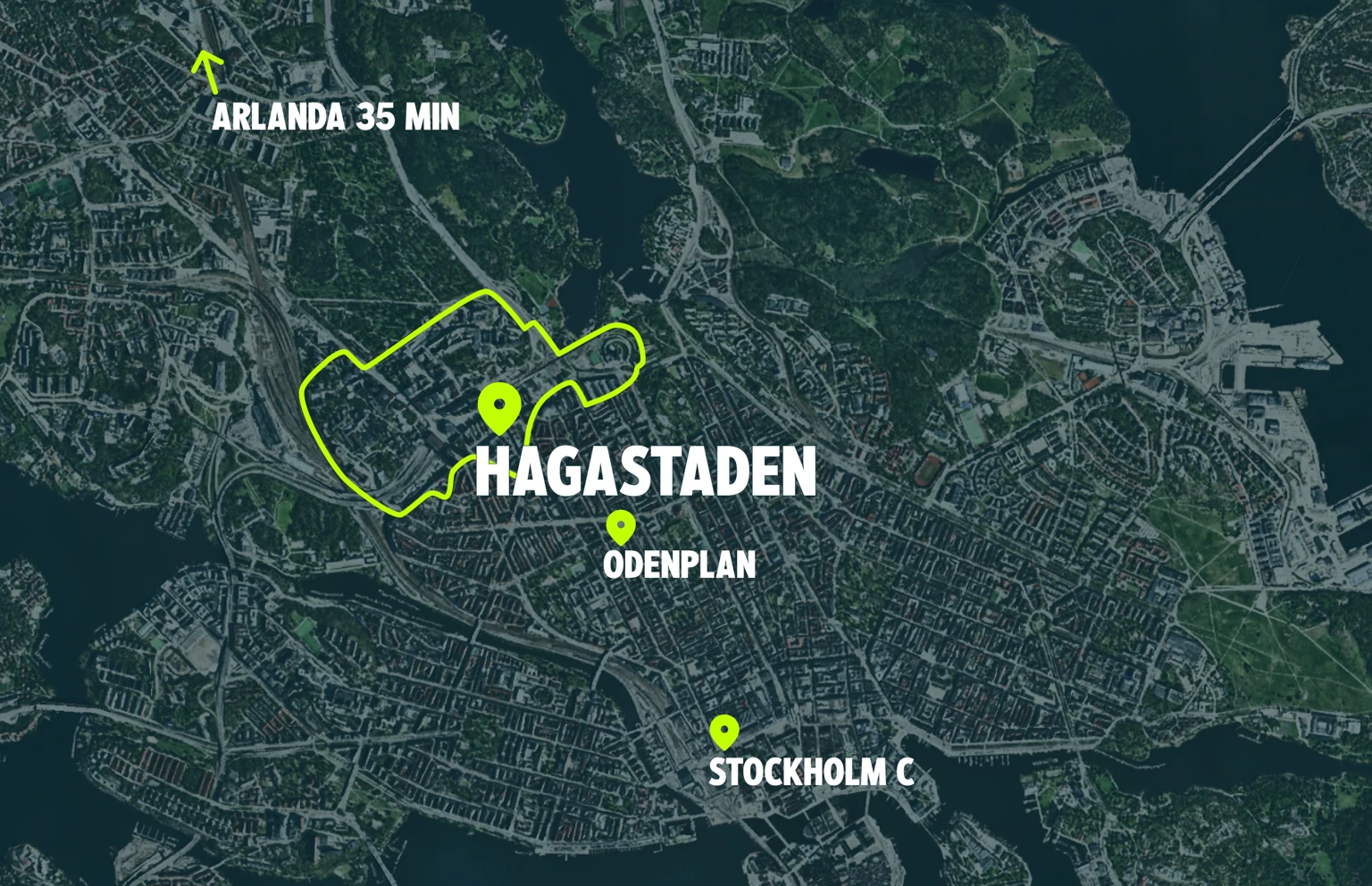
Hagastaden enjoys a unique geographical location with close proximity to Stockholm city center and Solna. The neighborhood is incredibly easy to reach, no matter how you choose to travel.
Distances from Torsplan in Hagastaden:
- 2 min by car to the E4 highway.
- 3 min walk to the commuter train (Odenplan / Vanadisvägen).
- 8 min walk to the S:t Eriksplan and Odenplan metro stations.
- 7 min by metro to T-Centralen (once the new Hagastaden station opens in 2028).
- 30 min walk (2 km) from Stockholm Central Station (or 10 minutes by bike/public transport).
Smooth travel to and from Arlanda Airport
- The E4 highway is just a couple of minutes away by car, making trips to and from Arlanda Airport effortless. The travel time is approximately 35–40 minutes for the 40 km journey.
- Airport Coaches (Flygbussarna): Run directly from Arlanda to the Karolinska Sjukhuset Eugeniavägen or Karolinska Sjukhuset Norra stops.
- Arlanda Express: Travels between Arlanda and Stockholm Central Station, where you can easily catch the metro or a bus connection to Hagastaden.

Subway Extension – Traffic Start in 2028
The good accessibility that already exists in the area will be further strengthened when the district gets a new subway station. Along the new stretch from Arenastaden to Odenplan, the stations Hagastaden, Södra Hagalund, and Arenastaden will be built.
The travel time between Hagastaden and T-Centralen will be 7 minutes. The Hagastaden station will have two entrances. The entrance towards Karolinska will have three entrances: one at Karolinska University Hospital, one at Hagaplan outside the hospital, and one at the intersection of Nobel’s väg and Solnavägen. The entrance towards Torsplan will be at the intersection of Torsgatan/Norra Stationsgatan. At Odenplan, the tracks will connect to the green line of the subway.
Traffic start is scheduled for 2028.
Here you can find the map of the subway extension and more information about the subway project: Green Line to Arenastaden.

Cutting-Edge Architecture
Hagastaden is defined by an international atmosphere, where the modern architecture of the new district meets the characterful industrial heritage buildings of Vasastan.
Here you will find the iconic Norra Tornen (The Innovation Towers), whose unique, pixelated silhouette has become a striking landmark on Stockholm’s skyline. Meanwhile, Cederhusen points the way toward future sustainable development as one of the world's largest mass-timber housing projects.
The result is a vibrant and dynamic landscape—where every building adds something unique to the city's character, creating an urban environment that both makes a bold statement and builds meaningful connection.
Frequently Asked Questions & Answers
Hagastaden is already a dynamic district with workplaces, housing, shops, and other services. The development of the district will continue for another 5-10 years.
Would you like to read more about the urban development of Hagastaden? Visit Centrala Hagastaden - Stockholm City.
Hagastaden is geographically located in both Stockholm and Solna, and it borders the district of Vasastan. The area includes Karolinska University Hospital and the iconic landmarks of Norra Tornen.
The P-House Hagastaden will have over 1,000 parking spaces and will become Stockholm Parking's longest garage, measuring 550 meters. The garage features up to 3 underground levels. It is divided into three sections: West, Center, and East, each with separate entrances. All parking spaces will be equipped with charging stations for electric cars.
The easiest way is to contact the property owners who are established in the district to discuss your needs:
It's great that you're considering moving to Hagastaden!
Keep an eye on the property owners who are building new homes and releasing apartments for sale:
You can also find homes that are already on the market through real estate agents. Simply search for the keyword “Hagastaden” on housing websites to get an overview.
The association Föreningen Hagastaden consists of around 20 members, the majority of whom are property owners. The association has been working together since 2010. Its main purpose is to support the vision for Hagastaden and the development of one of the world's leading areas for Life Science. The association's overarching goal is to collaborate and work together to create a long-term, attractive, and sustainable district for everyone who works, operates, lives in, or visits the area.
The main tasks of the association are:
To ensure the sustainable development of the district over time, focusing on both people and the environment.
To safeguard property values over time. This is achieved through various methods and perspectives, and the association plays a key role in highlighting the challenges that exist.